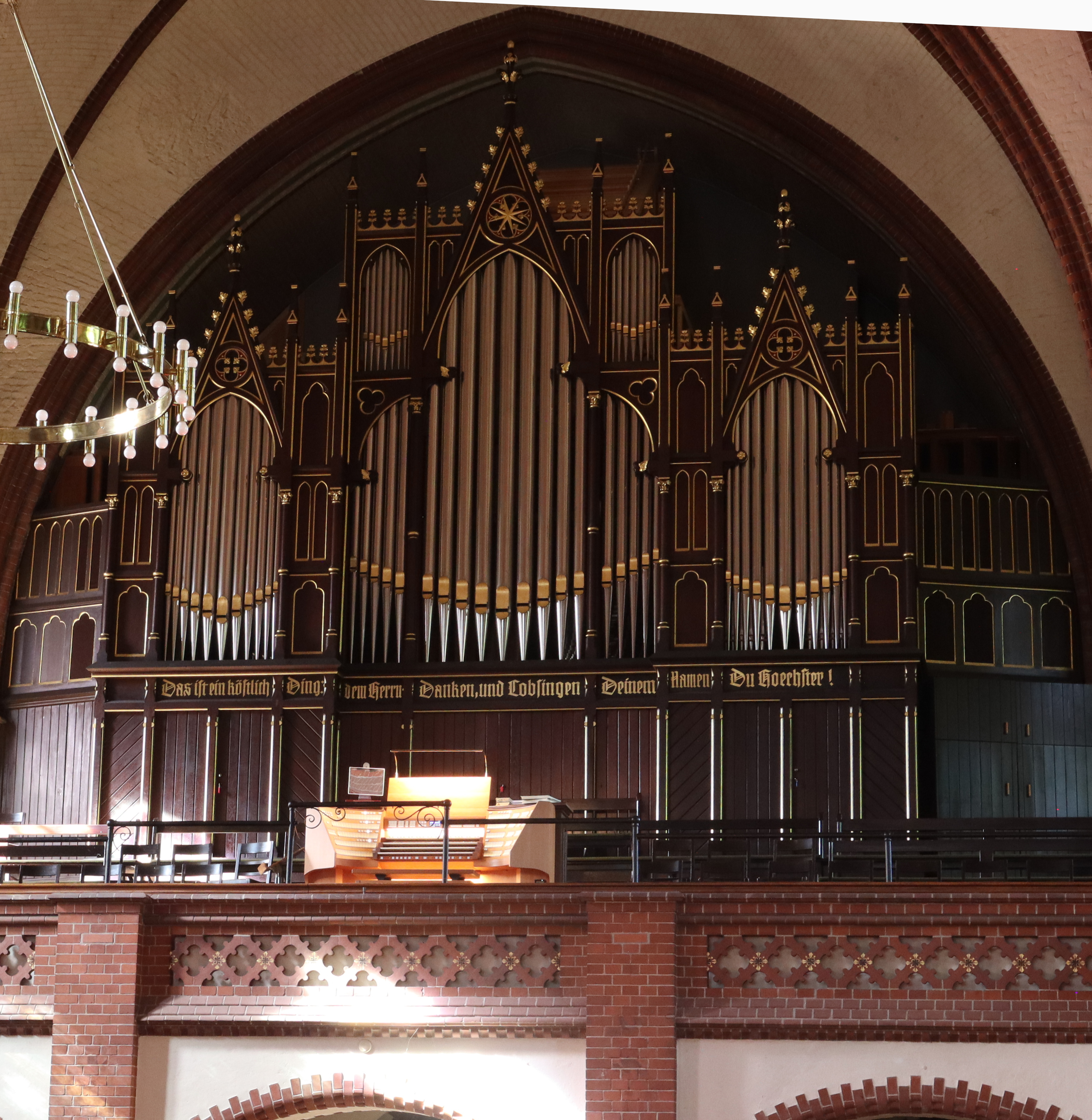
The Auenkirche in Berlin-Wilmersdorf is a three-aisled brick hall church in Neo-Gothic style, built between 1895 and 1897 according to the plans of Max Spitta. It stands on the former site of the “village green” ("Aue") of Wilmersdorf, which gave it its present name. Inside, one finds among other things a triptych by the artist Helena Starck, which after a varied history is now displayed on the side gallery. The Auenkirche is a lively parish space with an active concert program: thanks to its excellent acoustics, organ, choir, and brass concerts are held regularly.
The organ was built in 1897 by the organ-building company Furtwängler & Hammer, donated by the building contractor Christian Blisse. Originally, it had 41 stops on two manuals and pedal. Between 1921 and 1924 it was extensively expanded to 62 stops, and in 1928 another rebuild followed in the spirit of the emerging organ reform movement.
During World War II the instrument suffered damage but remained largely intact. In the following decades its sound changed significantly—especially through neo-baroque modifications. In 1961 the organ was expanded to four manuals and about 78 stops and additionally received a mechanical console. From the 1980s onward, the desire arose to emphasize the romantic sound character once again.
By 2022 the organ was technically in poor condition; only about one third functioned flawlessly. Therefore, in 2022–2023 it was restored by the organ-building company Rieger, deliberately oriented toward the sound image of the 1920s. Today the Auen organ, with 85 stops, is one of the largest church organs in Berlin and impresses both acoustically and visually.
The goal of the restoration was to reestablish the romantic-symphonic sound ideal. The current sound is described as “deeply romantic yet open”—ideal for late Romantic music such as Reger or Franck, but also versatile enough for Bach, Sweelinck, or Ligeti. Tonally, the organ is divided into five divisions: two swell divisions, a positive, a great, and the pedal. This allows for a wide dynamic range, from delicate, floating tones to powerful, orchestral fullness.